The new era of the web isn’t about navigation or info sharing. It’s about conversations.
By Kevin Cale - eDesign, Executive Director, Experience Strategy & Innovation
The web is changing fast. It is no longer just a place to click through menus and read pages; it is becoming a place to have real conversations with brands and services.
When you design an LLM‑powered website, you are not just arranging layouts and modules. You are creating a digital experience that can understand people, learn from every interaction, and adapt in real time. Instead of being built around rigid pages and navigation, these sites are built around intent, context, and continuous learning for every visitor.
Across industries—from government and healthcare to travel and finance—organizations are already experimenting with this new model. They are asking a different core question: not “How do we organize our content?” but “How do we orchestrate intelligence so every interaction feels clear, personal, and trustworthy?”
Image: Indiana State Government's LLM-Powered Website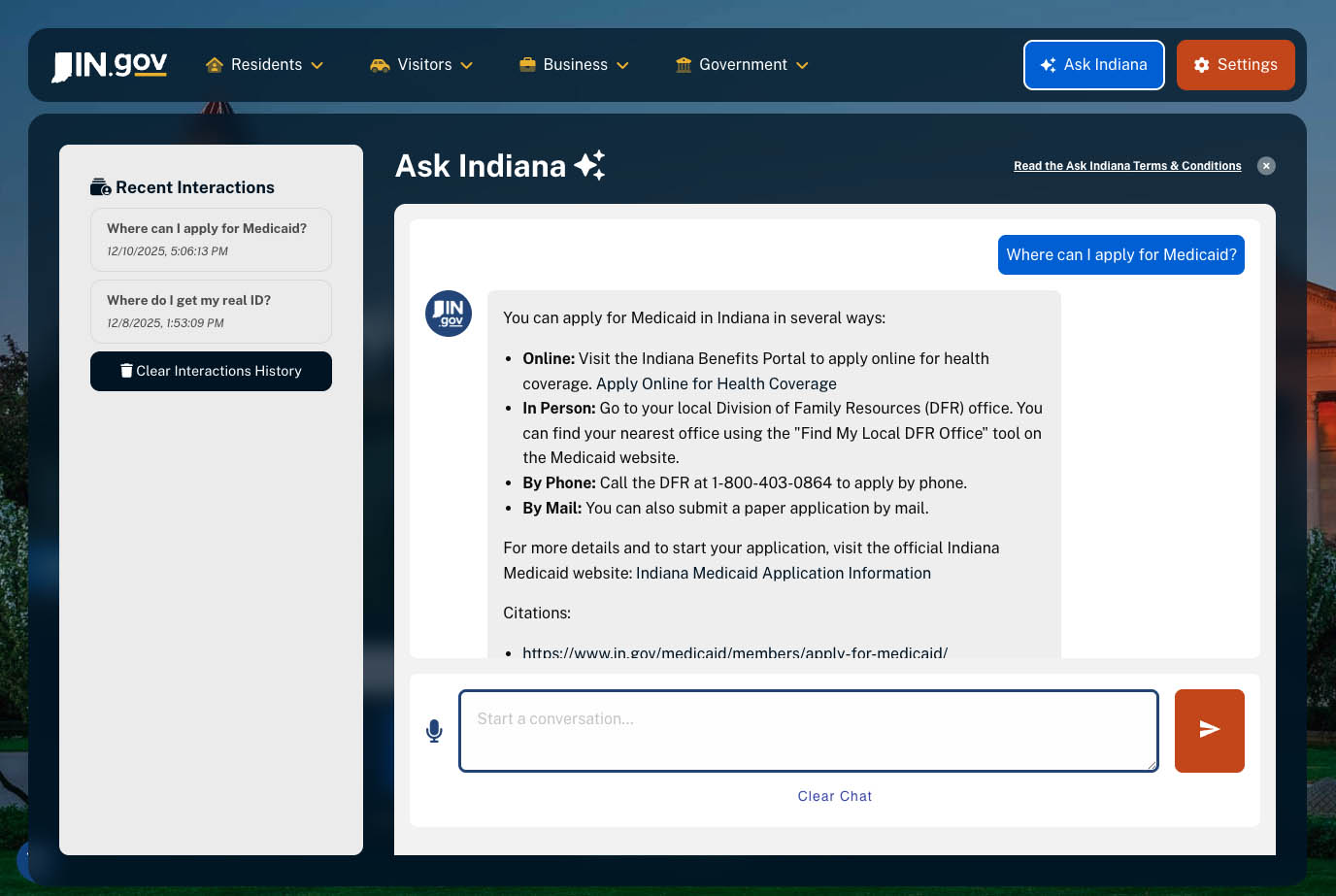
Start with behavior, not layout
For years, web projects started with sitemaps and wireframes. Those tools are still useful, but they are no longer the starting point. In an intelligent site, the real work begins by defining how the system should behave in different situations and states of mind.
That means asking questions like:
● How should the experience interpret what someone means when they type or speak in natural language?
● How should it remember what happened during past visits and carry that forward?
● How should it guide a decision, instead of just showing a long list of options?
In practice, this looks like scenario mapping and conversation design. You define example intents such as “I need to renew my license,” “Help me choose the right plan,” or “I’m not sure what I need yet.” Then you outline the ideal conversational flow, content, and interface changes that would help each person move forward. Visual design comes after these behaviors are clear, not before.
Think about a public portal where residents type what they need in their own words instead of digging through deep menus. An AI assistant can sit above the site’s structure and route people directly to the right information or action. It feels more like talking to a helpful guide than wrestling with a filing system.
Give your AI clear jobs
A common mistake is to treat the LLM as a single, generic chatbot sitting in the corner of the page. In reality, the AI does its best work when it has clear, specific roles at different moments in the journey.
Four roles tend to show up again and again:
● Guide: Helps people figure out where to start, what is possible, and what is most important right now.
● Curator: Pulls together content, data, and tools from across systems into a single, coherent response so users do not have to piece it together themselves.
● Strategist: Offers forward‑looking recommendations such as plans, next steps, bundles, or sequences based on context and history.
● Conversational UI: Acts as the main way people interact with the experience, letting them use natural language instead of rigid forms and menus.
One practical way to design this is to create “role cards” for each job the LLM will perform. For each role, define what data it can use, how it should speak, where it lives in the interface, and how success will be measured. This approach prevents one vague assistant from trying to do everything and makes it easier to design, test, and improve each role over time.
Design around intent, not navigation
Traditional information architecture starts with organizing content into sections, pages, and navigation trees. In an LLM‑powered experience, that logic flips. Intent becomes the primary organizing principle, and navigation becomes the backup, not the main act.
You can see this shift in a few simple patterns:
● Clear, prominent entry points that invite people to “Tell us what you need” instead of hiding conversation behind a tiny chat icon.
● Search that behaves like a conversation, allowing follow‑up questions and clarifications rather than a single keyword query.
● Interfaces that respond to intent with a tailored path or flow, not just a link to a long, static page.
Imagine an airline assistant where a traveler can say, “I want to upgrade my seat on next week’s flight.” The system understands who they are, finds the right trip, and walks them through options without forcing them to click through multiple booking pages. The home page in this kind of experience becomes less of a billboard and more of a living dashboard, reshaping itself as the system learns what the visitor is trying to accomplish.
Design in layers: human, orchestration, systems
The best AI‑driven experiences look simple on the surface, but they sit on top of a layered architecture that keeps everything working smoothly. Designing an intelligent site means being intentional about how these layers work together.
● Human Interaction Layer
This is everything the user feels and sees: chat and voice interfaces, adaptive layouts, micro‑interactions, visual feedback, and tone of voice. Design work here includes conversation flows, message patterns, system states (like typing, thinking, and loading), and transitions between conversational and traditional UI.
● Orchestration Layer
This layer is the “traffic controller” that turns human language into actions. It includes prompt frameworks, guardrails, memory strategies, and decision logic for when to call which internal or external service. Here you decide what context the LLM always has, what it should never see, and how it should route each request.
● Systems Layer
This is your foundation: content platforms, product databases, analytics, CRMs, authentication, and external APIs. For LLM‑powered experiences, these systems need to be structured and accessible so the orchestration layer can query them efficiently and safely.
When these layers work well together, the complexity disappears for the user. What they feel is speed, clarity, and empathy, not the machinery behind the scenes.
Image: Qatar Airways’ Digital Concierge, Sama, on their website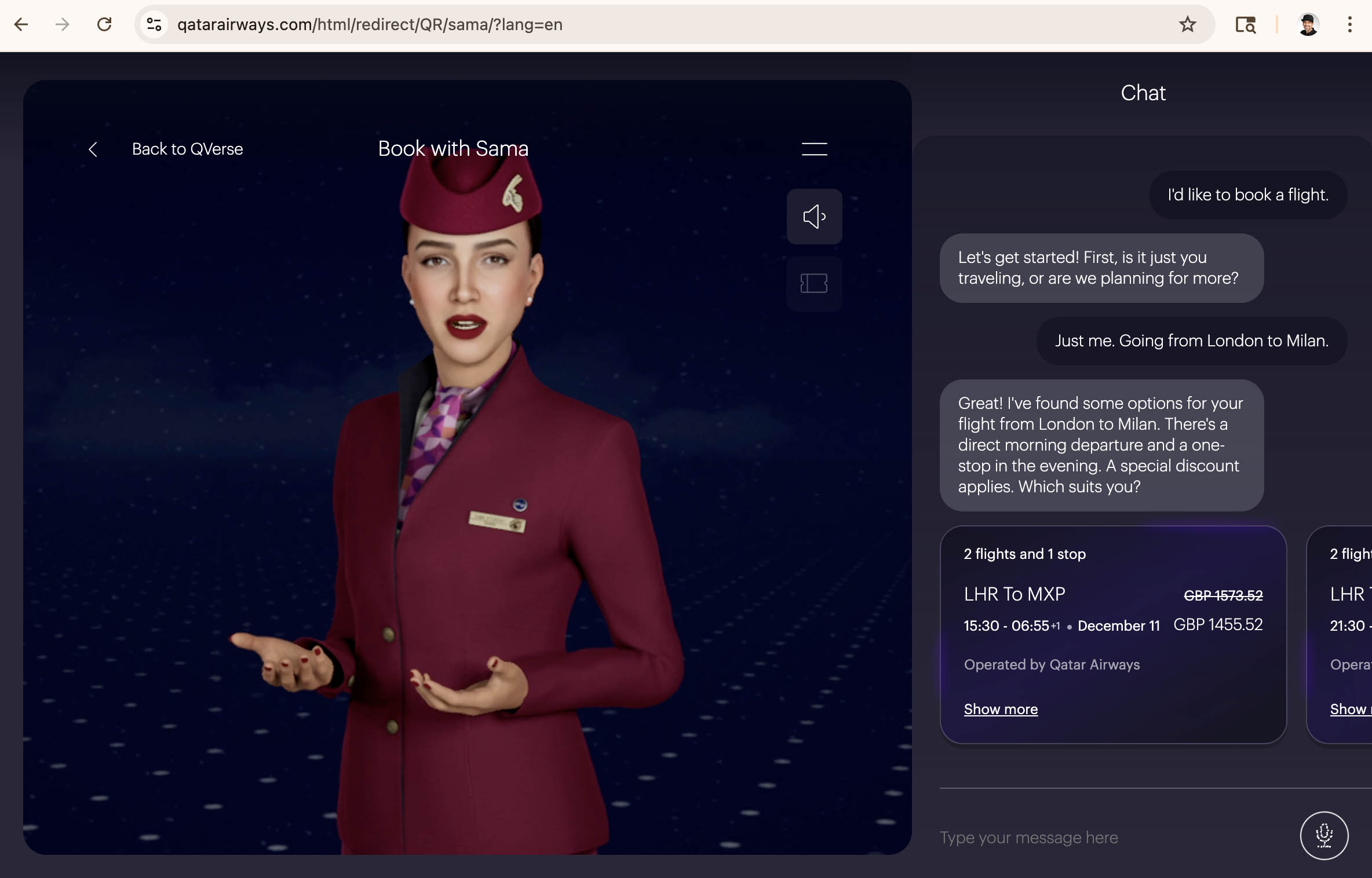
Shape content for AI, not just people
In an intelligent web, your words are not just marketing copy; they are part of your data model. Content has to be written and structured so that machines can understand it, recombine it, and reason over it. That calls for a shift from long pages to modular, structured knowledge.
In practical terms, that means:
● Breaking long pages into smaller content blocks with a clear purpose, such as definitions, step‑by‑step instructions, eligibility rules, comparisons, or FAQs.
● Applying consistent metadata and tags like topics, audience segments, lifecycle stage, tone, and risk level so the LLM can assemble the right content for each moment.
● Defining explicit relationships between content pieces, such as which guide belongs to which product or which FAQ supports which policy.
● Encoding brand voice, “do‑not‑say” rules, and opinionated stances as system‑level instructions, not just guidelines stored in a PDF.
Think of it like building a flexible story kit. Instead of one long article that everyone must read, you create well‑labeled building blocks that can be combined into personalized responses while still sounding exactly like your brand.
Image: Marriott’s Homes & Villas LLM-Powered Website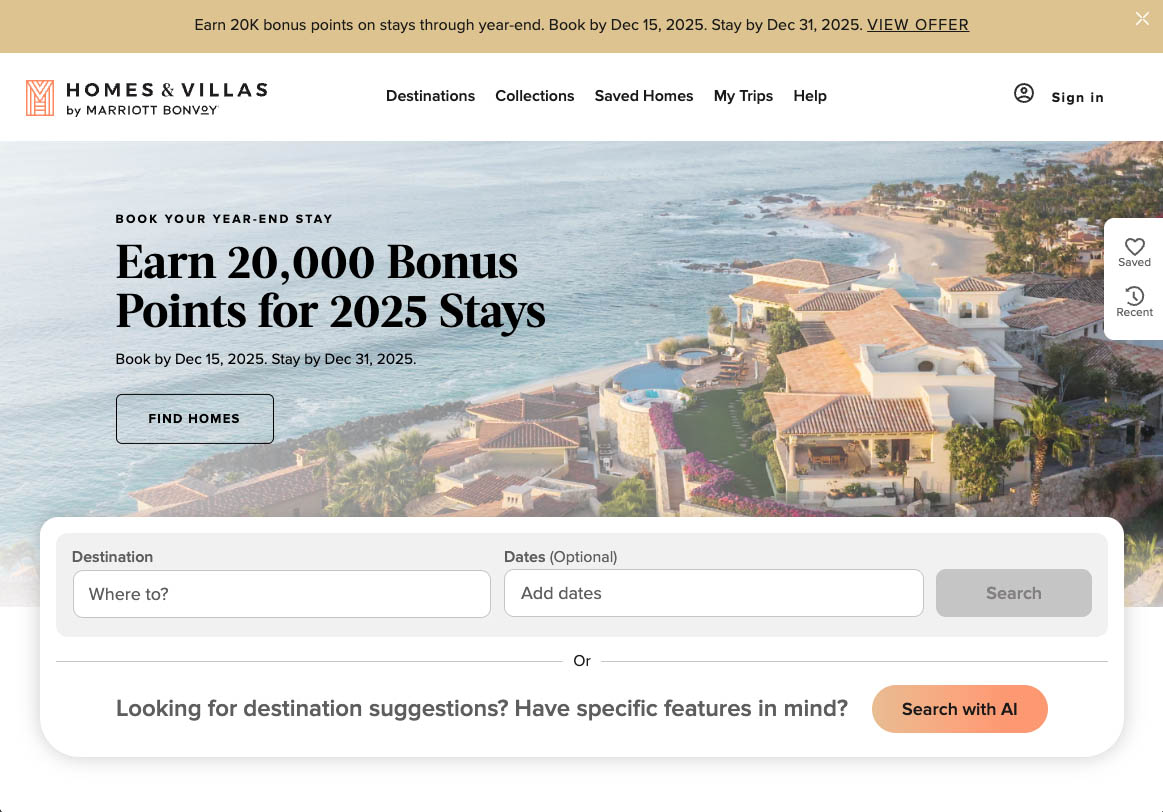
Build trust into the experience
When an AI speaks on behalf of your brand, trust is not a nice‑to‑have; it is the material you are designing with. People need to know why they should trust what they are seeing and what will happen with the information they share.
Trust‑centric design in an LLM website includes:
● Showing where important information comes from through citations, links to policies, and references to verified sources.
● Explaining why a specific recommendation or answer was generated, for example, “because of your past purchases” or “due to updated regulations.”
● Giving people easy ways to correct the system, flag issues, or ask for a second opinion.
● Clearly stating what the AI can and cannot do, especially in sensitive areas like health, finance, and legal topics.
When an assistant cites official documentation, offers a path to a human expert, and explains its reasoning in plain language, it sends a strong signal of transparency and reliability. A confident experience is not one that never makes mistakes; it is one that is honest and clear when it does.
Think in feedback loops, not funnels
Traditional digital journeys are often modeled as funnels: awareness, consideration, conversion. Intelligent websites behave more like living systems. They learn from every interaction and use that learning to make the next interaction better.
Designing for feedback loops means:
● Treating follow‑up questions, edits, and “this was not helpful” responses as input for learning rather than as failures.
● Using session history and past visits to refine future responses without forcing people through complicated profile settings.
● Designing simple, natural feedback prompts such as “Was this helpful?” or “What did we miss?” and feeding those signals into model tuning and rules updates.
Over time, the experience should feel less like starting from scratch on every visit and more like continuing a conversation with a brand that remembers what matters to you.
Image: Nike's LLM-Powered Website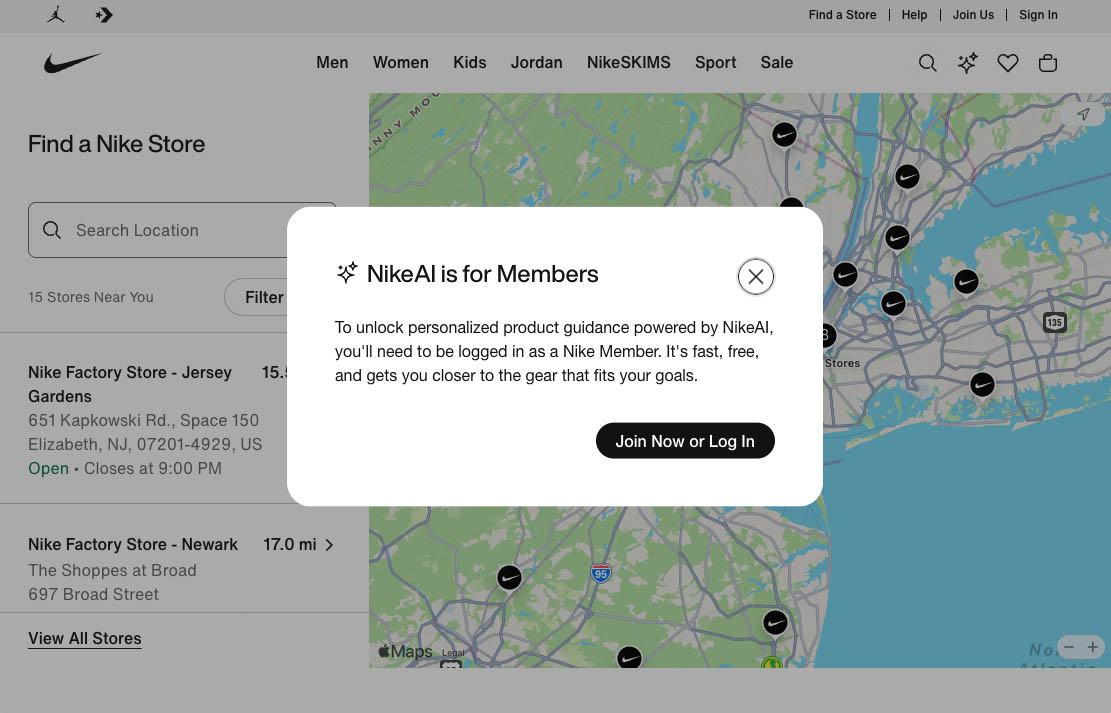
Plan for uncertainty and failure
Even the strongest models will sometimes be slow, uncertain, or wrong. Great design assumes this and plans for it up front. A premium intelligent site is defined as much by how it behaves when things go wrong as by how it behaves when everything works perfectly.
Helpful questions to ask include:
● What should happen if the model takes too long to respond?
● How should the system communicate uncertainty—saying “I am not sure”—without sounding broken or dismissive?
● When is it better to hand the conversation off to a human or to a more traditional interface, and how should that hand‑off happen?
When the AI cannot resolve an issue confidently, it should be able to bring in a human while keeping the context and conversation history intact. The user should feel like they are being escalated appropriately, not forced to restart their story from the beginning
Treat your UI as a living system
In an LLM‑powered website, your design system is no longer static. Components, layouts, and tone become dynamic, responding to context and user state instead of remaining fixed.
A “living system” approach includes:
● Components that can change their content, prominence, or behavior based on what the model detects, such as surfacing extra help when confusion is likely.
● Layouts that adapt not just to screen size but to intent, bringing forward tools, summaries, or deeper detail depending on what the user is trying to do.
● Tone that flexes from formal to friendly and from concise to more explanatory, based on risk level, domain, and user preference.
Done well, the site starts to feel less like a static catalog and more like a knowledgeable, responsive consultant that shapes itself around each person’s needs in the moment.
Traditional sites vs. intelligent sites
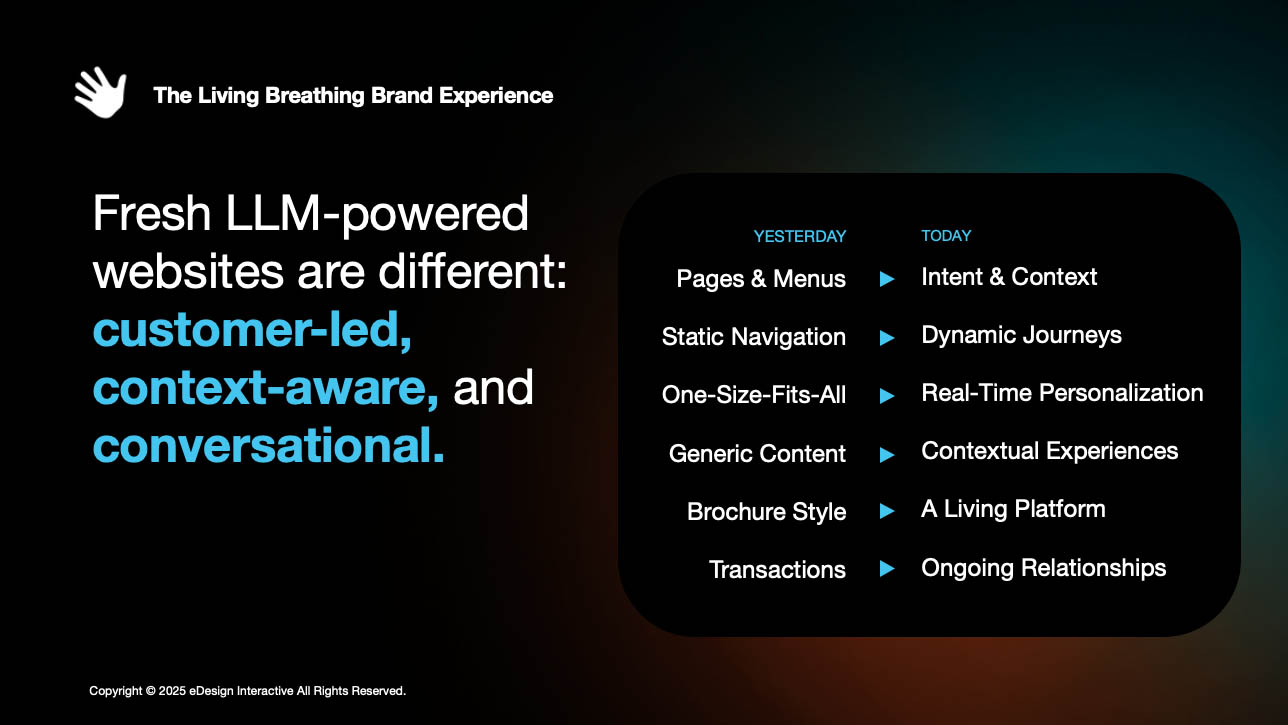
Traditional websites are built around pages and navigation. Their main job is to help people find the right section and then click or read their way through. Intelligent sites shift the center of gravity from structure to intent.
In an intelligent model:
● The experience is powered by LLMs that understand what users are trying to achieve.
● A layer of intelligence shapes truly personalized journeys in real time.
● Interfaces adapt as people ask new questions or change direction, rather than forcing them down a fixed path.
For teams, that means the design brief evolves from “Let’s build a website” to “Let’s build an intelligent interaction layer for our business.” The site becomes less of a destination and more of a responsive front door to everything the organization can do.
Designing relationships, not just interfaces
This shift represents a deeper redefinition of what a “digital experience” really is. A website is no longer just a container for content; it becomes a relationship channel that grows smarter and more helpful with every interaction.
When your site can listen, reason, and adapt, you move from designing static pages to designing intelligence and collaboration. The value is not only in faster answers; it is in building better relationships—experiences that respect people’s time, understand their context, and meet them where they are.
In the end, you are not just designing a new interface. You are designing a product brain that can understand, support, and evolve with your customers in real time.
Looking to design a smart digital presence that captures your organization’s vision and impact? Let’s build something extraordinary together. Connect with us to discuss your needs.